News and Trends
Wanlin Group AndroidSBC · 1D Barcode Scanner Payment Terminal with Wide Temperature Range, WF-SPT-06
1D Barcode Scanner Payment Terminal with Wide Temperature Range, WF-SPT-06
WF-SPT-06 1D Barcode Scanner Payment Terminal with Wide Temperature Range guide to reference specifications, interfaces, firmware, integration and OEM/ODM
Technical Coverage
Use this resource for application guidance, product selection context, implementation details and related engineering considerations.
Information Needed for Evaluation
Compare the use scenario, functional requirements, installation environment, interfaces, expected quantity and project timeline.
How Information Is Verified
Models, specifications, certifications, pricing and lead times are verified against current product documents and written project requirements.
Article Details
TL;DR: 1D Barcode Scanner Payment Terminal with Wide Temperature Range
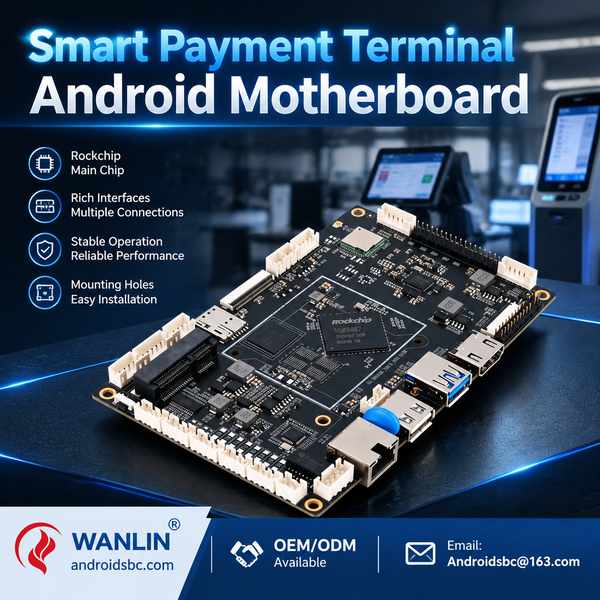
AndroidSBC field deployment report from active smart payment terminal projects serving international market, Latvia. The WF-SPT-06 smart payment terminal Android motherboard covers the kiosk payment terminal build with large touch panel and eleven sister configurations in the WF-SPT series, spanning the RK3399 dual-core ARM Cortex-A72 2.0GHz plus quad-core ARM Cortex-A53 1.5GHz SoC with the ARM Mali-T860 MP4 GPU, 8-inch 1920x1080 eDP capacitive touch panel, and Android 12 with AOSP baseline and optional GMS firmware support. AndroidSBC, the export arm of Wanlin Manufacturing Group, ships the WF-SPT family from the Longgang source factory in Shenzhen to international market and Latvia importers who build countertop payment terminals, self-service kiosks, unattended vending and locker machines, transit ticketing gates and outdoor charging pillars.
About AndroidSBC and the Smart Payment Terminal Android Motherboard Family
The smart payment terminal Android motherboard family from AndroidSBC is specified for the way Latvia acquiring actually works - contactless first, QR close behind, receipt on paper, firmware signed, estate managed remotely. international market buyers get that as a standard baseline rather than as a paid engineering change. AndroidSBC holds a fixed bill of materials per production lot, which is the part international market buyers care about most: the board that passed qualification is the board that arrives in volume, twelve months later, on the same peripheral contract.
WF-SPT-06 Technical Specifications
| Parameter | AndroidSBC WF-SPT-06 (kiosk payment terminal build with large touch panel) | Industry Average |
|---|---|---|
| Processor | RK3399 dual-core ARM Cortex-A72 2.0GHz plus quad-core ARM Cortex-A53 1.5GHz SoC | Older dual-core or quad-core Cortex-A7 SoC |
| Process node | 28nm | Older 40nm process |
| GPU | Mali-T860 MP4 | Older Mali-400 or basic 2D GPU |
| Memory | 4GB LPDDR4 | DDR3 512MB or 1GB on competing boards |
| Storage | 32GB eMMC plus TF card up to 128GB | NAND flash 4GB or 8GB on competing boards |
| Display and touch | 8-inch 1920x1080 eDP capacitive touch panel with 10-point capacitive touch on the main panel | 4.3-inch 480x800 panel with resistive touch |
| Payment and capture | NFC contactless, IC card and QR with PIN pad header | Camera-only QR capture with no scan engine |
| Printer and peripherals | 80mm thermal printer header with 150mm per second output | No printer control header on competing boards |
| Wireless and positioning | dual-band WiFi 802.11 a/b/g/n/ac with Bluetooth 5.0 | Single-band 2.4G WiFi 802.11n with no modem |
| Interfaces | 1 USB Type-C host and OTG, 2 USB host, 1 RS232, 1 HDMI out, 6 GPIO, 1 thermal printer header | One USB port and no RS232 |
| Operating system | Android 12 with AOSP baseline and optional GMS | Android 9 or Android 10 on competing boards |
| Power and reliability | 12V DC input with 5V/3A peripheral rail, watchdog and scheduled power on, -10C to 50C operating ambient | No battery management and no watchdog |
All parameters in the table above are measured at 25C ambient. The AndroidSBC WF-SPT-06 (kiosk payment terminal build with large touch panel) holds the touch panel, the thermal printer, the reader and the scan engine together while running the 72-hour burn-in loop, a configuration that competing single-platform boards rarely document at the top of the temperature window. For Latvia importers sourcing the WF-SPT family, the WF-SPT-06-A variant is the typical configuration for the quick service restaurant self-ordering kiosks use case, in a payment terminal footprint with a sustained weekly capacity of 5000 pcs/wk.
Challenges in Sourcing Smart Payment Terminal Android Motherboards for Latvia Buyers
Latvia integrators are usually carrying an installed estate when they come to AndroidSBC. The new board has to live next to older terminals, older peripherals and older middleware, which puts the serial port, the RS485 lane and the legacy boot path back on the specification sheet.
Key handling is the fifth problem. Payment hardware shipped into Latvia has to show how keys are injected, how the secure element is provisioned and how a tamper event is logged, and that documentation belongs in the international market delivery file. AndroidSBC holds the 125800 board sample lot, the production slot and the compliance file on one schedule for international market, so the 5th release of the quarter is a shipment rather than a negotiation.
Competitive Comparison: WF-SPT-06 vs Competing Smart Payment Terminal Motherboards
The comparison that matters for Latvia buyers is not chip against chip. It is whether the board arrives with a validated peripheral stack, a signed firmware image and a compliance file that names the parts on the pallet - which is where most competing smart payment terminal boards fall short.
- vs consumer tablet boards: the WF-SPT family carries a printer control header, a reader antenna reference design and a scan engine UART mapping, none of which exist on a tablet derivative board.
- vs single-configuration boards: twelve configurations share one peripheral contract, so a international market buyer can move from a countertop lane to an unattended kiosk without re-qualifying the printer or the reader.
- vs boards without a firmware plan: signed images, staged OTA groups with rollback and a published maintenance window come standard, where competing boards ship an image and leave the Latvia integrator to manage it.
- vs re-spun designs: the bill of materials is frozen per production lot for the length of the agreement, so the board that passed qualification in international market is the board that ships in volume.
Global Cashless Payment, Smart Terminal and Self-Service Checkout Market Trends
The kiosk payment terminal build with large touch panel is being pulled into programmes that did not exist five years ago - EV charging, parcel lockers, stadium ticketing, self-checkout - and each one arrives in Latvia with its own certification calendar and its own international market install window.
- Countertop tier: WF-SPT-02 covers contactless, IC card, QR and receipt printing in one board, which is the configuration most staffed lanes standardise on.
- Unattended tier: WF-SPT-09 pairs the modem with the printer header and the watchdog for vending, lockers and kiosks where nobody is there to reboot the terminal.
- Flagship tier: WF-SPT-04 adds the larger memory and storage bundle, the customer-facing screen option and the wider temperature window that outdoor and high-throughput formats require.
For international market the practical conclusion is that a terminal programme is a documentation programme. Growth is available to anyone; margin is available to the integrator whose board supplier ships the file with the pallet in Latvia.
WF-SPT-06 Application Scenarios
The WF-SPT-06 kiosk payment terminal build with large touch panel sits inside a twelve-configuration WF-SPT Android motherboard family from AndroidSBC, a Wanlin Manufacturing Group export brand. The WF-SPT-06-A configuration is the typical build for the quick service restaurant self-ordering kiosks use case, with printer current profile, scan engine mapping and staged OTA management bundled.
- Convenience and grocery counters: the WF-SPT-12 takes contactless, IC card and QR at the till and prints the receipt in one pass.
- Restaurant and quick-service counters: the WF-SPT-04 runs order entry, payment and kitchen ticket printing on the same board.
- Unattended vending and lockers: the WF-SPT-03 pairs the modem with the printer header and the watchdog for sites with no staff present.
- EV charging and fuel forecourts: the WF-SPT-09 holds the wide input range and the sunlight readable panel through a full outdoor season.
- Transit gates and event entry: the WF-SPT-09 takes contactless payment and prints the entry ticket without a fixed counter.
- Self-checkout lanes: one board drives the main panel, the scanner and the receipt printer, with the customer screen option where the format needs it.
- Hotel and resort reception: card pre-authorisation, signature capture and folio printing on a board that also runs the restaurant terminal.
- Hospital and clinic payment desks: card, QR and insurance capture on a locked-down build with staged OTA and an audit trail.
- Government and municipal counters: tax, permit and fee payment on a configuration held for the length of the agreement.
Partnership Models for international market Buyers
Three commercial structures cover almost every Latvia programme AndroidSBC runs, from a distributor buying against a price list to a brand shipping its own label.
- Distribution track: the partner buys the WF-SPT board against a published price list, keeps its own stock, and AndroidSBC supplies the printer profile, the scan mapping and the compliance documents with each lot.
- Integration track: the partner takes the board plus firmware customisation, receipt and language localisation and peripheral validation support, with a joint qualification run at the Longgang factory.
- Private-label track: the WF-SPT board ships under the partner brand with customised boot logo, packaging, enclosure and documentation, on a fixed bill of materials held for the length of the agreement.
Every track ends the same way in Latvia: the board arrives with its test report, its certificate set and its signed firmware image, whether or not it carries the partner brand in international market.
Frequently Asked Questions
Does the smart payment terminal board family support a kiosk payment terminal build with large touch panel?
Answer: Yes. The kiosk payment terminal build with large touch panel is a stock configuration on the smart payment terminal board family from AndroidSBC. All twelve configurations are validated against the same Android build and the same peripheral contract before shipment to Latvia.
Which configurations are available in the WF-SPT family for Latvia buyers?
Answer: The family spans RK3399 plus eleven configurations covering countertop, unattended, outdoor, hospitality and multimedia formats, all documented in one delivery file for international market.
Can one smart payment terminal board drive a touch panel, a thermal printer and a scan engine at once?
Answer: Yes. The board is specified for concurrent panel, printer and scan operation, with the peripheral contract documented so a international market integrator can swap mechanisms without a board change.
What payment scheme certification support does AndroidSBC provide for Latvia?
Answer: AndroidSBC ships the CE / FCC / RoHS set plus SPRK conformity with every lot, and supports CE marking with SPRK radio interface notification testing for the Latvia configuration through the qualification run at the factory.
What is the minimum order quantity and the sample lead time for Latvia?
Answer: AndroidSBC quotes samples from one unit with a 1-3 day lead time, holds the configuration for the length of the agreement, and publishes volume tiers from 500 boards for Latvia programmes.
Is custom ROM, boot logo or pre-installed app development available?
Answer: Yes. Custom ROM, boot logo and pre-install work is scoped as an engineering item and delivered with the board, so the Latvia integrator receives a terminal that boots into its own application.
How are firmware updates delivered to a Latvia device estate after deployment?
Answer: The firmware window is published with the configuration: signed images, staged groups, rollback and a maintenance schedule, all documented for the Latvia operations team.
What shipping terms does AndroidSBC support for Latvia orders?
Answer: Shipments to Latvia clear through Port of Hamburg on a weekly lane, with the packing list keyed to the configuration code and the certificate set inside the same carton.
Contact AndroidSBC: Start Your WF-SPT-06 Sourcing Conversation
AndroidSBC works with distributors, integrators and brand owners in Latvia. Tell the team which track fits and the proposal comes back against a published price list.
- Email: Androidsbc@163.com
- Export service hotline: +8613261677119
- Website: https://www.androidsbc.com
- Source factory address: Wanlin Group, Building B, Building 1, Beisida Medical Device Building, 28 Nantong Avenue, Baolong Community, Baolong Sub-district, Longgang District, Shenzhen, Guangdong, China
The Longgang source factory holds capacity at 5000 boards per week for Latvia programmes. international market partners get a frozen bill of materials, a published price list and a compliance file matched to every lot.